


los pro-Trump y los anti-Trump»


Nadim Shehadi (Beirut, 1956) does not feign neutrality. This Lebanese economist and political analyst has chosen a side and does not bother to hide it: he prefers a Middle East articulated around the Gulf and peace with Israel rather than one dominated by Iran.
With the bias clarified, the conversation can now proceed with spontaneous honesty, historical erudition, fierce irony and Mediterranean digressions.
Nadim Shehadi, during a class at Tufts University.
Shehadi was director of the Fares Center for Eastern Mediterranean Studies at Tufts, the Center for Lebanese Studies at Oxford, the academic center at Lebanese American University in New York, and the Middle East program at Chatham House.
He has written for The New York Times, Guardian and cnnand publishes a semi-regular column in Arab News. He has also started on Substack, where he defines himself as a «repentant economist and historian.» amateur«.
A teacher of teachers, he has influenced both prestigious SOAS analysts and Christiane Amanpourone of the visible faces of CNN.
From his home in Beit Meri, in Mount Lebanon, Shehadi watches the Israeli bombs fall, interrupting this conversation on several occasions.
We talk about Lebanon, Iran, and overly emotional analysts, while the war and the entire Middle East comes through the window.
How do you see direct negotiations between Lebanon and Israel?
It all depends on the mechanism. What matters in a negotiation is who talks to whom and about what. The problem with the ceasefire of November 27, 2024 is that the current Lebanese Government is trying to implement an agreement that it did not negotiate, after a war that it did not fight, and with conditions that it cannot meet.
The main one is the disarmament of Hezbollah, and this mechanism gives the impression that Beirut is asking Hezbollah to disarm on behalf of Israel. That’s not going to happen.
What you have to do is separate the tracks. On the one hand, the Lebanese state can demand the disarmament of Hezbollah based on Taif, because the militias had to disarm and become political parties. On the other hand, Lebanon has to negotiate with Israel without giving the impression of capitulating, because that would strengthen Hezbollah.
After today’s meeting in Washington, the Israeli ambassador said that if Hezbollah does not disarm, there will be nothing to talk about.
The statements of the Israeli ambassador are going to cause a great stir in Lebanon. These conversations will be controversial and it is very brave of our Government to get involved in them. But they are the only way.
Statements like this make it more difficult for the Lebanese Government. There will be a political confrontation with Hezbollah over this issue. It is fine as long as it remains political and does not turn into violence against the Lebanese Government.
Isn’t it contradictory that Israel continues bombing?
Not necessarily. When you want to negotiate, it also shows that you are serious. And sometimes that means bombing. European history is full of treaties whose negotiation was prolonged because, every time the parties got stuck, they returned to war and later renegotiated based on the military result.

What would you say is Netanyahu’s strategy in Lebanon today?
To begin with, I don’t believe that story that the only reason Netanyahu is doing this is to delay a trial. That’s too simplistic. But his strategy no longer seems to be what it used to be.
Before, Israel occupied part of the country, but the population was still there. Now the strategy seems to be to depopulate, completely destroy, make the area uninhabitable and turn it into a buffer strip.
It is an atrocious strategy. It will not work, and in the long run it will weaken Israel because it will strengthen its enemies.
Hezbollah can emerge politically stronger, although it ends up militarily weaker. It already happened after 2006: Israel destroyed the country and no one came to defend it, so Hezbollah was able to come back and say: «If we are not here, no one will protect you.» That argument gains strength with each cycle of destruction.
You describe Israel in very harsh words, although you prefer it strategically.
Yes, because one thing does not invalidate the other. Israel has become something monstrous. What Netanyahu is doing in both Gaza and Lebanon has social support within Israel.
Many people underestimate the impact that the Hamas attack of October 7, 2023 had on Israeli society. A population that saw itself as liberal, humanitarian and guided by certain moral values has come to accept the destruction and depopulation of Gaza, and also the devastation of the Lebanese population.
If there were elections tomorrow, those who asked for peace would not win. It is a very dangerous phase, for Israel and for the entire region.
What explains this turn?
October 7 activated the worst inherited fears: the Holocaust, the pogroms, the feeling of existential threat. This has created a climate in which the ethnic cleansing and depopulation of southern Lebanon and Gaza is tolerated.
It is a very dangerous state of mind. And, in the long term, it is also impracticable. You can’t live surrounded by enemies forever.
You maintain that limiting the negotiation with Iran to the nuclear file would be repeating a mistake.
Exactly. That was the great clumsiness of the nuclear agreement. Iran got the United States to discuss the nuclear file alone, and that gave it time and room to act everywhere: Hezbollah, Syria, Iraq, the Houthis. What we saw on October 7 was, in part, the result of that mistake.
Iran could previously say: we negotiate on the nuclear issue, we have nothing to do with Hezbollah, nor with the Houthis, nor with Iraq, nor with Palestine. That is no longer credible.
If sanctions are lifted and the discussion is reduced to nuclear issues again, it would be giving Iran—or, more accurately, the Revolutionary Guard—time and resources to rebuild its networks and consolidate its positions. He should not be allowed that maneuver again.
Its central thesis is that the region can no longer be analyzed as a sum of separate conflicts.
Exact. The art of war is to keep the battle far from your own territory, and for years Iran succeeded in doing so. He fought through Hezbollah, the Houthis, the Iraqi militias and the Syrian regime. He could intervene in the entire region without appearing fully as a protagonist. Americans also saw it that way.
For a long time, many experts could continue to pretend that these actors were autonomous, semi-autonomous or simply local. After October 7 that became much more difficult to sustain.
There was a sequence: the Hamas attack, then Hezbollah, then the Houthis, then the Iraqi militias, and finally Iran launched a salvo of test missiles. Everything began to seem like a coordinated game. And once the board is revealed as an interconnected system, the only way to combat it is to confront Iran.
Before one could say: this is Lebanon, this is Gaza, this is Yemen, this is Iraq. Not anymore. Iran has shown too much the extent of its tentacles and has made itself a target.
There are those who continue to treat Hezbollah as if it were not part of that Iranian network.
That’s false. The relationship is not superficial or opportunistic: it is historical, ideological and organic. There is no doubt that Hezbollah became a branch of the Revolutionary Guard. The same thing happens, in different ways, with the Houthis and the Palestinian Islamic Jihad. Hamas was also recruited and financed by Iran.
In this framework, why does Iran hit the Gulf countries so hard?
Because they are its true regional adversary. Iran represents a radical, militant, anti-imperialist and anti-American Islamist model.
The Gulf countries represent something else: open economies, modernization, integration into the global economy, festivals, grand prizes, investment, peace with Israel.
I don’t think this is, in essence, a Shia-Sunni war. There are radical Shiites and Sunnis on the same side, like Hezbollah and Hamas. The real division is between radicalism and a more liberal model for the region.
You insist that you are not a neutral observer.
I am not an objective, neutral and independent observer. I clearly see two possible futures for the region, and I am clearly on the side of one of them. I want one to prevail and the other to retreat. One model is the one that the Gulf countries embody today: peace with Israel, integration into the global economy and a more liberal regional order.
The other is a scenario in which, if Iran prevails, these countries gradually become subject to Revolutionary Guard-style militant factions.
Yes: I want the United States and the Gulf countries to win, because I prefer peace. I am in favor of peace with Israel, although I am not saying that I want the Israelis to win, because they are destroying my country.
But strategically, Israel is in the US-Gulf bloc vis-à-vis Iran and its proxies, and I prefer the general view of that bloc to that of the Islamic Republic, also for the sake of Iran and its own population.
You are very critical of Western analysts. What do you blame them for?
That they project too much. That’s why I wanted to talk about Hafez al Assad (1930-2000, the late president of Syria). When Israel withdrew from Lebanon in May 2000, some interpreted Assad’s silence as evidence of deep wisdom, of almost civilizational strategic patience.
Two days later he was dead: he had been in a coma for some time and was artificially kept alive. The expert was imagining a strategy where there was none.
Something similar happens with Iran and with Donald Trump. Many people feel the need to force a consistency that they do not understand. And, furthermore, there is a lot of emotionality, especially in the United States.
Some anti-Trump pundits seem to prefer a US defeat rather than admitting that Trump may be right about something. That distorts the analysis.
Is that why you reject the idea that Trump completely lacks strategy?
I reject the confidence with which many affirm it. In war, in chess, even in love, one does not fully reveal one’s strategy. The more unpredictable you are, the more margin you have.
Trump has been operating like this for decades. His mind has always operated in the same way: apparent incoherence, unwavering security, the ability to continue talking as if nothing went wrong.
That doesn’t automatically prove that there is a brilliant strategy, but it also doesn’t prove that there isn’t one. The problem is when others fill that void with fantasies. Frankly, there are two kinds of fools in this war: the pro-Trump and the anti-Trump.
Trump is both an emperor and a gangster. An emperor because the United States is an imperial power with a deep aversion to imperialism and colonialism, and a historical tradition favorable to self-determination. Trump has no patience for such dilemmas. It is purely transactional and focused on getting the job done.
He is also very critical of Europe.
Because I want him to be successful. Europe is reacting emotionally, with old anti-American sentiments. And the same thing happens in Washington, where polarization has become almost tribal. This type of polarization contaminates the reading of war.
Europe, of course, is not in favor of the future that the Iranian Revolutionary Guard imagines. Pedro Sánchez wants to play the hero, challenge the «emperor of the world», Trump, but European interests are not with a nuclear Iran, owner of the Middle East.
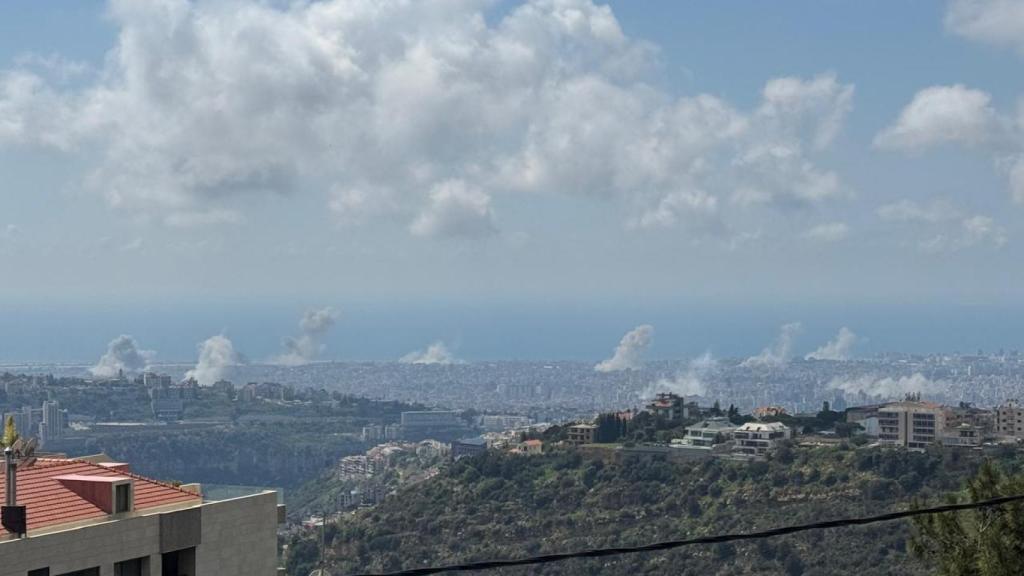
The bombings against Beirut seen from Nadim Shehadi’s house.
And what reading should we make of Iranian society and diaspora?
It’s complex. There is a big difference between Iranians within and in the diaspora, the latter tend to see everything in black and white. They live in a dilemma: they want the end of the regime, but not with war.
Puedes consultar la fuente de este artículo aquí